Mounting the Foil

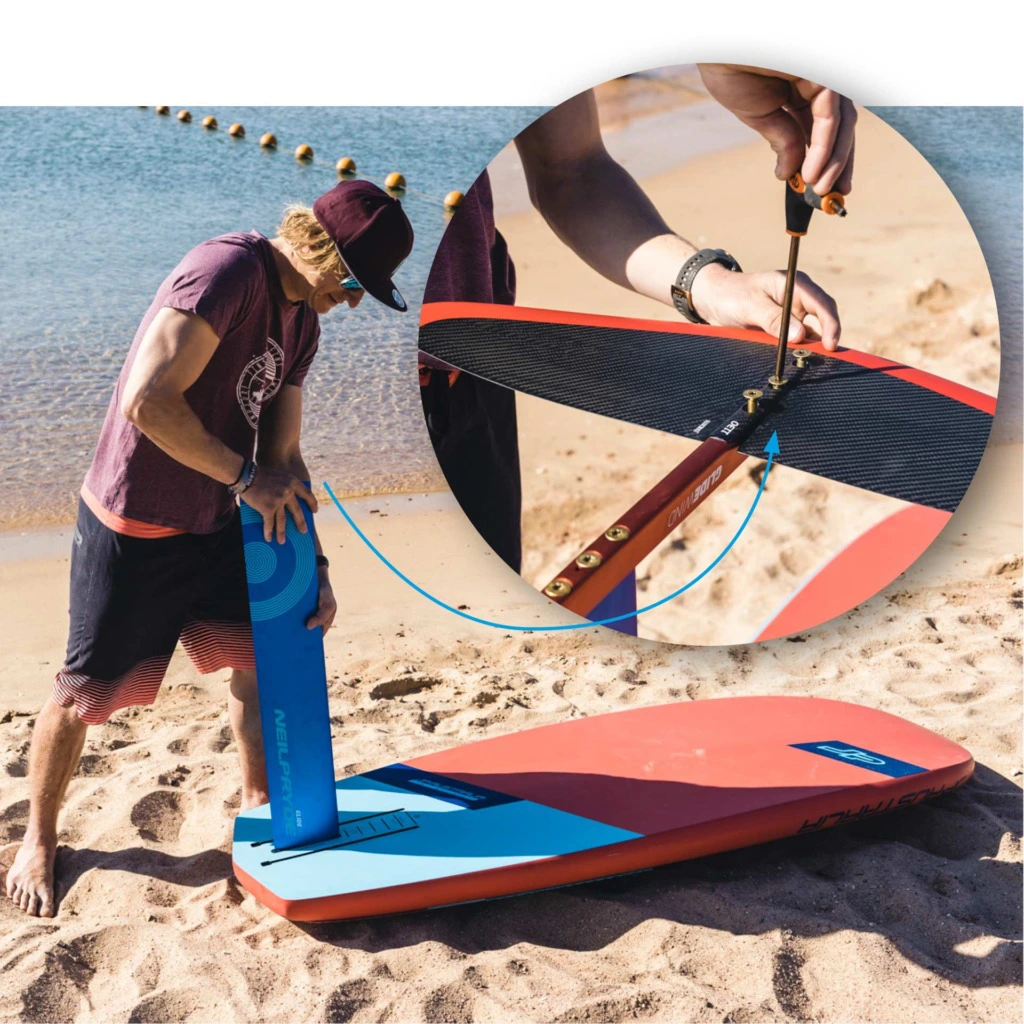
Attach the base to the mast.
Resist your impulse to assemble the whole foil right away because it is much easier to fix only the mast to the board first. The front screw is the more important one as it has to resist all tensile forces and therefore has to be long!

The next step is to mount the fuselage to the mast – comfortably at waist height – and afterwards the wings to the fuselage.
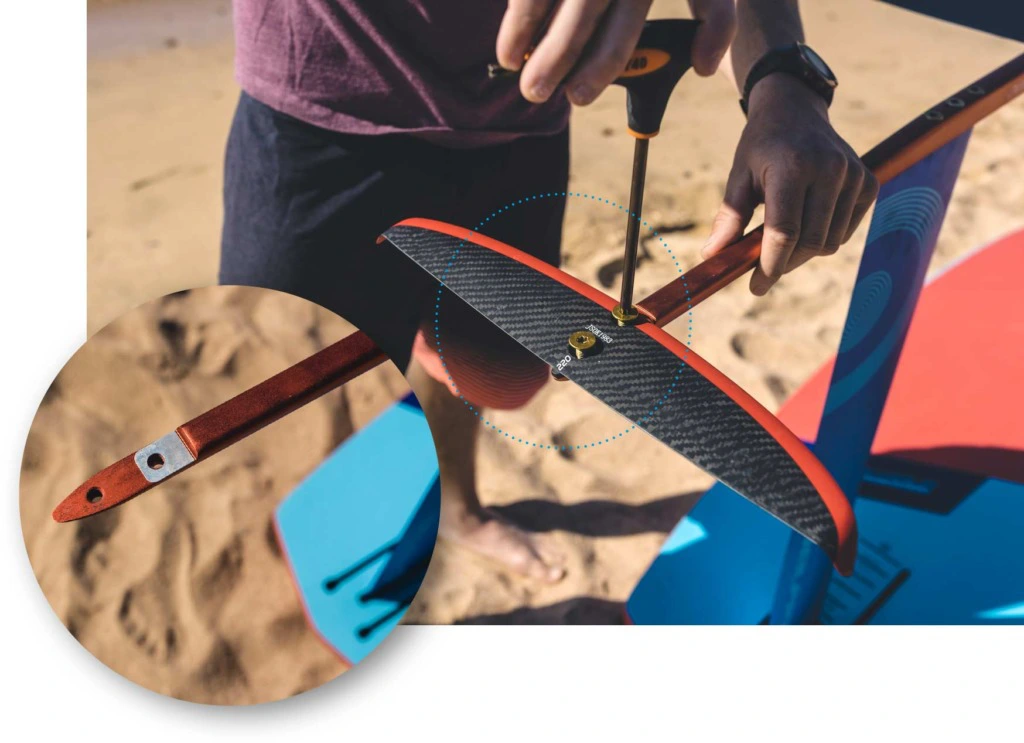
After finishing up, a hefty push forward/ down of the foil mast will show you if the foil is already deep enough in the box. Tighten the screws if necessary.

Tip:
Loosening the screws can be challenging and sometimes is impossible especially when the foil was used in saltwater and mounted on the board for a long time.
To avoid this,
we highly recommend to

  • treat the screws with grease or copper paste before assembly to prevent erosion
  • loosen the screws a little after water action
  • repeat this procedure with every session.

Common mistake: The angle of the wing should not be adjusted to the rider’s weight. Only the wing size should follow the rider’s weight, meaning the heavier rider requires larger wings to avoid stalling and to start planning as early as the lighter rider.

Angle the tail wing to adjust the lift of the foil.

A spacer at the front screw of the tail wing increases the lift.

A spacer at the rear screw of the tail wing reduces the lift.

The 2nd spacer coming with GLIDE foil will reinforce the desired effect.

The amount of lift a rider individually needs depends on:

  • the size of the board
  • the foot strap positions and
  • the sail size

Example: When swapping to a larger sail, add a spacer at the front screw to even out the higher weight and downforce of the bigger sail.

Entgegen dem ersten Impuls zuerst das ganze Foil zu montieren, ist es einfacher zu­nächst nur den Mast im Board zu verschrau­ben. Die vordere Schraube ist die wichtigere, denn hier wirken sämtliche Zugkräfte, sie muss unbedingt lang genug sein.

Danach lassen sich die Flügel bequem auf Bauch­höhe an der „Fuselage“, dem „Rumpf“, montieren.

Am Ende hilft ein kräftiger Ruck (Schub) am Foilmast Rich­tung vorne / unten, um zu sehen ob das Foil tief und fest genug in der Box sitzt. Die Schrauben ggf. noch einmal nachziehen.

Tip:
Damit die Schrauben auch nach längerer Montage und Salzwassergebrauch wieder lösbar sind, ist es ratsam folgende Tipps zu beachten  

  • behandle die Schrauben ein wenig mit Fett oder Kupferpaste, um Erosion zu verhindern
  • löse deine Schrauben nachdem du auf dem Wasser warst jeder Session auf dem Wasser
  • wiederhole die beiden Punkte nach jeder deiner Sessions

Häufiger Fehler: Der Winkel des Flügels sollte nicht an das Gewicht des Fahrers angepasst werden. Nur die Flügelgröße sollte dem Gewicht des Fahrers folgen, d.h. schwerere Fahrer benötigen größere Flügel, um Stalling zu vermeiden und genauso früh ins Gleiten und aufs Foil zu kommen wie leichtere Fahrer

Verstelle den Winkel des Heckflügels, um den Lift anzupassen.

Ein Distanzstück unter der vorderen Schraube des Heckflügels erhöht den Lift.

Ein Distanzstück unter der hinteren Schraube des Heckflügels verringert den Lift.

Das zweite mitgelieferte Distanzstück beim GLIDE Foil verstärkt den erwünschten Effekt.

Der Lift, den man beim Foilen erfährt, hängt von folgenden Faktoren ab:

  • die Boardgröße
  • die Fußschlaufenposition
  • die Segelgröße

Beispiel: Wenn du auf ein größeres Segel wechselst, lege ein beigelegtes Distanzstück unter die vordere Schraube, um die höhere Downforce des größeren Segels auszugleichen.

something
new
coming soon

Days
Hours
Minutes